


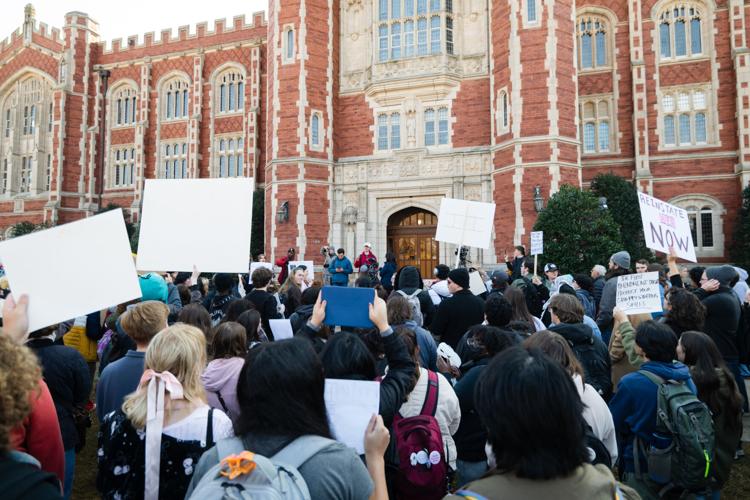
A recent essay at The University of Oklahoma (OU) has turned into a blazing controversy —–
One that’s raising questions about religious freedom, academic expectations, and how colleges respond when students clash over belief and scholarship.
What Happened
In November 2025, a junior psychology student at OU, Samantha Fulnecky, submitted a 650-word assignment for a psychology class on gender norms. The assignment asked students to respond to a research article examining how societal expectations of gender affect peer relationships and mental health among middle-schoolers.KOSU
Instead of analyzing the research findings, however, Fulnecky used the opportunity to express her religious beliefs —- citing the Bible and arguing that traditional gender roles reflect “God’s original plan” for humanity. She described social acceptance of transgender non-binary identities as “demonic,” according to the version of her essay circulated online.
When the paper was graded, her graduate teaching assistant gave her a 0 out of 25, saying the essay failed to respond to the prompt and lacked empirical evidence. The instructor reportedly criticized the essay for relying on personal ideology rather than engaging with the scientific content. https://www.whsv.com
The Fallout: Complaint, Review, and National Spotlight
Feeling that her grade reflected discrimination against her beliefs, Fulnecky filed both a grade appeal and a “religious discrimination” complaint with the university.
Responding to growing public attention, OU placed the graduate instructor on administrative leave and reassigned the course to a full-time professor while the incident is investigated.
Officials said they take seriously “concerns involving the First Amendment,” including religious freedoms. KPRC
Within days, the story exploded beyond the campus: a post shared by OU’s chapter of Turning Point USA (TPUSA) about the essay became viral, with millions of views online. The Journal Record
State officials also weighed in: Kevin Stitt, Governor of Oklahoma, urged the university’s board to review the process to make sure students aren’t penalized for expressing sincerely held beliefs.
The Wider Debate: Religion vs. Academic Standards
Supporters of Fulnecky argue this is a clear-cut case of religious discrimination and a threat to freedom of conscience and free speech on campus. They say penalizing her for expressing Biblical beliefs undermines students’ First Amendment rights.
Others —— including many students, faculty, and online commentators —– contend that the response was about academic standards, not ideology. On online forums such as subreddit dedicated to OU, some wrote:
“Yes, the essay was bad. No, it didn’t deserve a grade of 0 (a grade of 50 or 60, sure).” Reddit
“It’s not even making an argument for the research paper they were meant to be reacting to.” Reddit
Critics argue the essay failed not because of its views, but because it ignored the academic assignment: it lacked engagement with research findings, ignored empirical evidence, and instead presented personal and religious beliefs —— essentially turning a pyschology reaction essay into a personal opinion piece. The Washington Post
On the flip side, after the public outcry, OU removed the failing grade from the student’s record so it would not affect her final mark, while the investigation continues.
Why It Matters — For Colleges, Students, and Society
The controversy at OU isn’t just about one essay or one student —— it hits on larger, national tensions:
— The line between religious freedom and academic standards —– can personal faith justify academic arguments in classes rooted in empirical search?
— The role of free speech and viewpoint diversity on campuses: Do students have the right to argue religiously informed perspectives even if they contradict scientific consensus —- and should professors grade based on content or quality?
— The challenge of navigating identity, ideology, and inclusivity: For supporters of transgender rights and gender-identity acceptance, the content of the essay (calling trans identities “demonic”) crosses a boundary of respect and inclusivity; others see penalization as discriminatory.
— And finally —– how social media and activism amplify campus disputes into national controversies, often polarizing opinion before full facts emerge.
What’s Next at OU
As of this writing, the investigation into Fulnecky’s complaint is ongoing. The university has removed the zero from her record, pledged to review procedures, and reassigned the class. But the debate continues — among students, faculty, parents, and lawmakers — over how to balance academic integrity with free belief, how universities should respond to controversial opinion, and what type of environments colleges should foster.
For now, OU is at the center of a much larger story: one about faith, identity, education — and whether American campuses remain places where such debates can be had openly, respectively — and meaningfully.
This story goes to the heart of many of the current issues colleges and universities are grappling with today. Give us your opinion! Re-read “Why it matters” (the end of this story) and tell us what you think.
Julia Vitek | Dec 11, 2025 at 4:32 pm
Good work Walter
Charles Barrow | Dec 10, 2025 at 6:31 pm
Excellent article Walt.
Maite | Dec 10, 2025 at 11:48 am
Excellent article, Walter! Nice job sticking to the facts and presenting the story clearly and objectively. That’s not an easy task!!
Wyatt Garin | Dec 10, 2025 at 10:59 am
Great job Walter. Good job presenting the facts.